
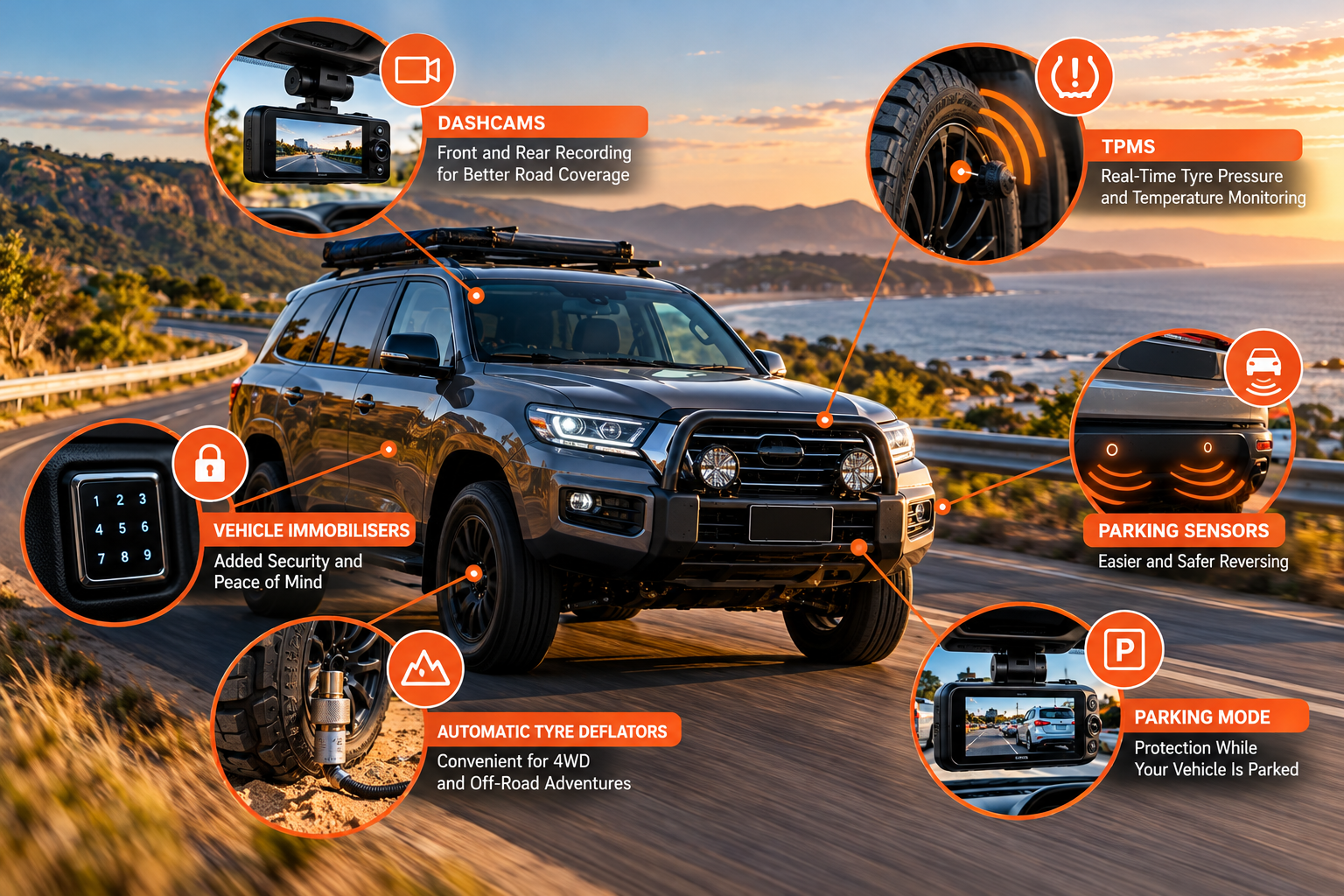
7 Essential Car Safety Accessories Every Australian Driver Should Consider in 2026
Vehicle safety involves more than airbags, seatbelts and modern driver assistance systems. While these built-in features play an important role in protecting motorists, additional automotive accessories can help drivers monitor their vehicles, record road incidents and improve awareness during everyday journeys.
Whether you’re commuting through Melbourne, navigating busy shopping centre car parks, towing a caravan or heading off-road for the weekend, choosing the right car safety accessories in Australia can make a practical difference.
From advanced dashcams and tyre pressure monitoring systems to parking sensors and vehicle immobilisers, today’s automotive technology offers more ways to stay informed and protect your vehicle.
In this guide, we’ll look at seven car safety accessories worth considering in 2026, explain how they work and help you decide which options suit your driving needs.
1. Front and Rear Dashcams for Better Road Coverage
A dashcam is one of the most useful automotive accessories for drivers who want a video record of what happens on the road.
While a front-facing camera captures the traffic ahead, a dual-channel dashcam adds rear coverage, recording vehicles approaching from behind and incidents that may not be visible through the front camera.
Why Consider a Front and Rear Dashcam?
Australian drivers encounter a wide variety of road conditions, from congested city streets to regional highways and remote touring routes.
A quality front and rear dashcam can help you:
- Record events occurring ahead of and behind your vehicle.
- Preserve footage that may be useful when reviewing a road incident.
- Capture additional details during unexpected traffic situations.
- Record in changing lighting conditions with suitable camera technology.
- Access parking recording features on compatible systems.
For example, if your vehicle is involved in a rear-end collision, rear-facing footage may provide useful context about the vehicles approaching from behind.
Features Worth Looking For
When comparing dashcams, consider video resolution, image sensor quality, HDR, night vision, recording reliability and parking mode options.
Premium models may offer 4K front recording, QHD rear recording, GPS location information and Wi-Fi connectivity for reviewing footage.
ParkPro’s VUEROID range includes options such as the D21-4K Ultra Front and Rear Dashcam and the S1 4K Infinite Front and Rear Dashcam.
Both provide front and rear recording, with features suited to drivers looking for detailed footage and modern connectivity.
Best suited for: Daily commuters, rideshare drivers, frequent highway travellers and motorists wanting broader video coverage.
Browse ParkPro’s front and rear dashcams.
2. Tyre Pressure Monitoring Systems (TPMS) for Real-Time Tyre Awareness
Your tyres are the only parts of your vehicle in direct contact with the road, making their condition particularly important.
Incorrect tyre pressure can affect handling, tyre wear, fuel consumption and braking performance. A significant loss of pressure can also create a dangerous situation, especially at highway speeds.
A Tyre Pressure Monitoring System (TPMS) helps drivers keep track of tyre conditions without relying solely on occasional manual checks.
How Does a TPMS Work?
An aftermarket TPMS typically uses sensors attached to tyre valves or installed within the wheels.
Depending on the system, these sensors transmit information to a display inside the vehicle, allowing drivers to monitor:
- Individual tyre pressure readings.
- Tyre temperature.
- Pressure changes during a journey.
- Alerts when readings move outside configured limits.
This information can be particularly valuable during long-distance driving, where changes in tyre pressure might otherwise go unnoticed.
Why Is TPMS Useful for Australian Conditions?
Australian driving can involve long stretches of highway, high ambient temperatures, changing road surfaces and heavy towing loads.
For drivers travelling with caravans, trailers or 4WD equipment, monitoring additional tyres can be especially useful.
For example, a TPMS may alert a driver to a pressure loss in a caravan tyre before the problem becomes visually obvious.
However, TPMS is an additional monitoring tool, not a replacement for checking tyre condition, tread depth, load ratings or pressures with a reliable gauge.
Choosing the Right TPMS
Consider the number of tyres you need to monitor, sensor type, display visibility, alert settings and suitability for towing.
ParkPro offers TPMS solutions for different driving and touring requirements.
Best suited for: Everyday drivers, 4WD owners, caravan travellers and motorists regularly towing trailers.
3. Rear Parking Sensors for Easier Reversing
Reversing can be challenging, even for experienced drivers.
Tight driveways, crowded shopping centres, narrow parking spaces and obstacles positioned below the rear window can make it difficult to judge available space.
Rear parking sensors provide additional information about nearby objects when manoeuvring at low speeds.
How Do Parking Sensors Work?
Most aftermarket rear parking sensor systems use ultrasonic sensors fitted to the rear bumper.
When the vehicle is placed in reverse, the sensors detect certain obstacles within their operating range.
Depending on the system, drivers receive audible alerts, visual distance information or both.
Warnings generally become more frequent as the vehicle approaches a detected obstacle.
Benefits of Rear Parking Sensors
Rear parking sensors can help with:
- Reversing into narrow parking spaces.
- Detecting some low-level obstacles.
- Manoeuvring near walls, posts and other vehicles.
- Parking in busy shopping centres.
- Improving awareness when visibility is restricted.
They can be particularly helpful for larger SUVs, utes and vehicles with limited rear visibility.
Parking Sensors vs Reversing Cameras
A reversing camera provides a visual view behind the vehicle, while parking sensors provide proximity alerts.
Using both can offer complementary information, but neither technology detects every possible obstacle.
Drivers should continue checking mirrors, looking around the vehicle and reversing slowly.
ParkPro’s parking sensor range offers options for motorists seeking additional reversing assistance.
Best suited for: Urban drivers, SUV owners, families and motorists frequently parking in confined spaces.
4. PIN Code Vehicle Immobilisers for Added Security
Vehicle security remains an important consideration for Australian motorists, particularly as thieves use increasingly sophisticated methods to gain access to vehicles.
Traditional keys, factory alarms and central locking provide important security functions, but some drivers may want another layer of protection.
A PIN code vehicle immobiliser is designed to help prevent unauthorised vehicle starting.
What Is a PIN Code Immobiliser?
A PIN code immobiliser requires a specific code or authorised sequence before the vehicle can be started or driven, depending on the system.
This adds another security step beyond possession of the vehicle’s key.
For example, even if an unauthorised person obtains a working key, an additional immobiliser may prevent the vehicle from being started without the correct authentication.
Benefits of an Additional Immobiliser
Depending on the product and installation, potential advantages include:
- An additional authorisation step before vehicle starting.
- Reduced reliance on the physical vehicle key alone.
- Discreet integration with vehicle controls.
- No need to carry an additional remote on some systems.
- Added protection against certain key-related theft methods.
Code Safe Key Start Immobiliser
The Code Safe Key Start Immobiliser available through ParkPro is designed to add PIN-based vehicle security.
It offers a personalised authentication process and discreet integration, providing another layer of protection alongside existing vehicle security features.
Important: Code Safe requires professional installation and is not offered as a DIY installation product. Installation availability and suitability should be confirmed for the specific vehicle.
No security device can guarantee that a vehicle will never be stolen, but a properly installed immobiliser can form part of a broader vehicle security strategy.
Best suited for: Owners of high-value vehicles, vehicles parked outdoors and motorists wanting additional anti-theft protection.
5. Automatic Tyre Deflators for 4WD Adventures
For many Australian drivers, vehicle safety extends beyond sealed roads.
Beach driving, sandy tracks and certain off-road conditions often require tyre pressures to be adjusted to suit the terrain and vehicle manufacturer’s guidance.
Automatic tyre deflators can make this process more convenient.
Why Adjust Tyre Pressure Off-Road?
Lowering tyre pressure appropriately can increase the tyre’s contact patch and improve flotation on suitable soft surfaces, such as sand.
However, the correct pressure depends on several factors, including:
- Vehicle weight and load.
- Tyre construction and size.
- Terrain conditions.
- Driving speed.
- Manufacturer and tyre specialist recommendations.
Driving at unsuitable pressures can damage tyres, reduce handling stability or increase the risk of a tyre separating from its wheel rim.
How Do Automatic Tyre Deflators Help?
Automatic tyre deflators allow drivers to set a target pressure and release air from their tyres without manually checking each tyre continuously.
This can make preparation for off-road travel quicker and more consistent.
For 4WD enthusiasts travelling in groups or moving between sealed and unsealed roads, the convenience can be particularly valuable.
Important Safety Considerations
Tyre deflators are not suitable for every driving situation.
Before returning to normal road speeds, tyres should be reinflated to the appropriate pressure using a suitable air compressor and checked with an accurate pressure gauge.
Drivers should also follow tyre and vehicle manufacturer guidance when adjusting pressures.
Best suited for: 4WD enthusiasts, beach drivers, campers and off-road touring travellers.
6. Dashcam Parking Mode for Protection While Parked
Dashcams are often associated with recording while driving, but some models can also monitor activity when a vehicle is parked.
Parking mode is particularly useful for drivers who regularly leave their vehicles in public car parks, apartment parking areas or other shared spaces.
What Is Dashcam Parking Mode?
Parking mode allows compatible dashcams to record or respond to certain events while the vehicle is stationary.
Depending on the camera, available recording modes may include:
Impact Detection: The camera saves footage when its sensor detects a significant impact.
Motion Detection: Recording may be triggered when movement is detected within the camera’s field of view.
Time-Lapse Recording: The camera captures images at intervals to create a condensed recording of activity.
Low-Power Parking Modes: Certain models use reduced-power standby functions and wake when specific events are detected.
Not every dashcam includes all these features, and some parking functions require compatible power accessories or professional installation.
Why Consider Parking Recording?
Parking mode may help capture useful footage of:
- Minor collisions involving parked vehicles.
- Certain incidents in public car parks.
- Vehicles approaching or leaving nearby spaces.
- Other events occurring within the camera’s recording area.
However, footage depends on camera positioning, lighting, power availability, event detection and whether the incident occurs within the field of view.
Choosing a Dashcam With Parking Mode
When comparing models, check parking recording methods, battery protection features, storage capacity and installation requirements.
Some VUEROID models available through ParkPro offer intelligent parking recording features, including the S1 4K Infinite.
Best suited for: Drivers parking in shared facilities, apartment complexes, shopping centres and public parking areas.
7. TPMS Signal Boosters for Caravans and Longer Vehicles
Tyre pressure monitoring is especially useful when towing, but longer vehicle combinations can introduce an additional challenge: maintaining reliable communication between tyre sensors and the in-car display.
This is where a compatible TPMS signal booster may help.
Why Might a TPMS Need a Signal Booster?
Wireless tyre sensors transmit information over a limited range.
On a standard passenger vehicle, the distance between the sensors and display is usually relatively short.
However, when monitoring caravan or trailer tyres, the signal may need to travel considerably further.
Vehicle construction, metal components, sensor position and other sources of interference can affect communication reliability.
What Does a TPMS Signal Booster Do?
A compatible signal booster helps relay communication between tyre sensors and the TPMS display.
It may be useful for:
- Longer caravans.
- Large trailers.
- Extended 4WD and towing combinations.
- Installations experiencing intermittent sensor communication.
A booster improves the communication link where compatible. It does not directly improve the accuracy of tyre pressure measurements.
Check Compatibility Before Buying
TPMS signal boosters are not universal accessories.
Before purchasing, confirm compatibility with your existing TPMS model, power requirements and recommended mounting position.
For example, ParkPro’s iCheck TPMS Signal Booster is intended for compatible iCheck systems. Buyers should confirm NEXTGEN compatibility before installation.
Best suited for: Caravan owners, frequent towing travellers and drivers with longer vehicle combinations.
How to Choose the Right Car Safety Accessories for Your Vehicle
Not every driver needs every accessory.
The most useful products depend on how you use your vehicle, where you travel and which risks or inconveniences you want to address.
| Driving Situation | Accessories Worth Considering |
|---|---|
| Everyday city commuting | Front and rear dashcam, parking sensors |
| Regular public parking | Dashcam with parking mode, vehicle immobiliser |
| Highway and regional driving | Front and rear dashcam, TPMS |
| Caravan and trailer towing | TPMS, compatible signal booster |
| Beach and off-road driving | Automatic tyre deflators, TPMS |
| Additional vehicle theft protection | Professionally installed PIN code immobiliser |
Before purchasing, consider vehicle compatibility, installation requirements, warranty coverage and how easy the system will be to use.
It is also worth remembering that electronic accessories complement safe driving habits rather than replace them.
Regular servicing, tyre inspections, appropriate speeds, maintaining visibility and following road rules remain fundamental to vehicle safety.
Why Quality and Installation Matter
When shopping for automotive safety accessories, price should not be the only consideration.
Product reliability, compatibility and installation quality can have a significant impact on performance.
For example, a dashcam with impressive specifications may still provide disappointing results if it is positioned incorrectly or uses unsuitable power accessories.
Similarly, an incorrectly installed parking sensor system may produce unreliable warnings.
A vehicle immobiliser should be installed by a suitably qualified professional to ensure correct operation and minimise the risk of electrical or compatibility problems.
Choosing reputable products and following manufacturer installation instructions can help ensure your accessories work as intended.
At ParkPro, Australian motorists can find automotive safety solutions covering dashcams, TPMS, parking assistance and vehicle security.
Frequently Asked Questions About Car Safety Accessories
What are the most useful car safety accessories in Australia?
Front and rear dashcams, tyre pressure monitoring systems, parking sensors and additional vehicle security devices are useful options for many Australian motorists. The best choice depends on your vehicle, driving conditions and individual requirements.
Is a 4K dashcam better than a 2K dashcam?
A 4K dashcam records at a higher resolution and can capture additional image detail under suitable conditions. However, image sensor quality, lighting, HDR, compression and camera positioning also affect footage quality. A good 2K dashcam may still provide excellent results for everyday driving.
Do I need TPMS if my vehicle already has a factory tyre pressure warning system?
Not necessarily. Some factory systems provide individual pressure readings, while others primarily warn of potential pressure loss. An aftermarket TPMS may be useful if you want additional information or need to monitor caravan or trailer tyres that your factory system does not cover.
Can parking sensors replace a reversing camera?
No. Parking sensors and reversing cameras provide different types of assistance. Sensors alert drivers to certain nearby obstacles, while cameras provide a visual view. Both have limitations and should be used alongside direct observation and mirrors.
Are PIN code immobilisers suitable for every vehicle?
Compatibility varies between immobiliser systems and vehicle makes, models and years. Professional assessment is recommended before purchasing or arranging installation.
Are automatic tyre deflators necessary for everyday driving?
Generally, no. Automatic tyre deflators are primarily useful for off-road applications where drivers need to reduce tyre pressures appropriately for certain terrain conditions.
Can a dashcam record when the car is switched off?
Some dashcams support parking recording when the ignition is off, provided they have a suitable power source and compatible installation. Recording duration and behaviour depend on the model, settings and available power.
Does every caravan TPMS need a signal booster?
No. Whether a booster is necessary depends on the TPMS model, towing combination length, signal range and installation conditions. Always check compatibility and manufacturer recommendations.
Final Thoughts: Invest in the Car Safety Accessories That Suit Your Driving
The best car safety accessories are those that address your actual driving needs.
A front and rear dashcam can provide additional video coverage, while TPMS helps you stay informed about tyre conditions. Parking sensors offer assistance when reversing, and a professionally installed immobiliser adds another layer of vehicle security.
For 4WD and caravan travellers, automatic tyre deflators and compatible TPMS signal boosters can also provide practical benefits during longer journeys.
As automotive technology continues to develop, Australian drivers have more choices than ever when it comes to monitoring, recording and protecting their vehicles.
The key is to choose quality products, confirm compatibility and understand how each accessory works.
Looking to improve your vehicle’s safety and protection?
Browse the ParkPro online store for premium dashcams, tyre pressure monitoring systems, parking sensors and vehicle security solutions.
Need help choosing a suitable product? Contact ParkPro for product information and assistance.